The Inevitable Revolution: 5 AI trends that are changing the Rules of the Business Game

Summary: Generative Artificial Intelligence (GenAI) has become essential in the business world. Companies should focus on five trends: building clear strategies, automating with Agentic AI, democratizing access, complying with ethical regulations, and prioritizing sustainability in order to navigate this technological revolution.

The Inevitable Revolution: 5 AI trends that are changing the Rules of the Business Game

Generative Artificial Intelligence (GenAI) has moved from being a promise to becoming a strategic priority. According toBCG, most companies in Spain already consider it key capability for 2025, and 85% plan to increase their R&D budget, which will be largely invested in deploying GenAI. The Spanish governmenthasalsoannounced an investment of €150 million ingrants to promote the use and integration of GenAI in companies. 

While some are still debating whether GenAI is a “hype” that will eventually fade, organizations that have already adopted it are reporting tangible benefits: operational optimization, improved decision-making, product and service innovation, and a more personalized customer experience.

But the breakneck speed at which this technology is evolving, and the pace at which users are adopting it, raises a critical question: how should companies prepare so they don’t fall behind?

The real key to GenAI success lies not only in technology, but in people. To successfully execute any AI strategy, organizations need a threefold approach: align objectives, foster an innovative mindset, and develop the right capabilities.  

In this article, we explore five key trends that will set the direction in the coming months for organizations looking to incorporate GenAI as part of their strategy.
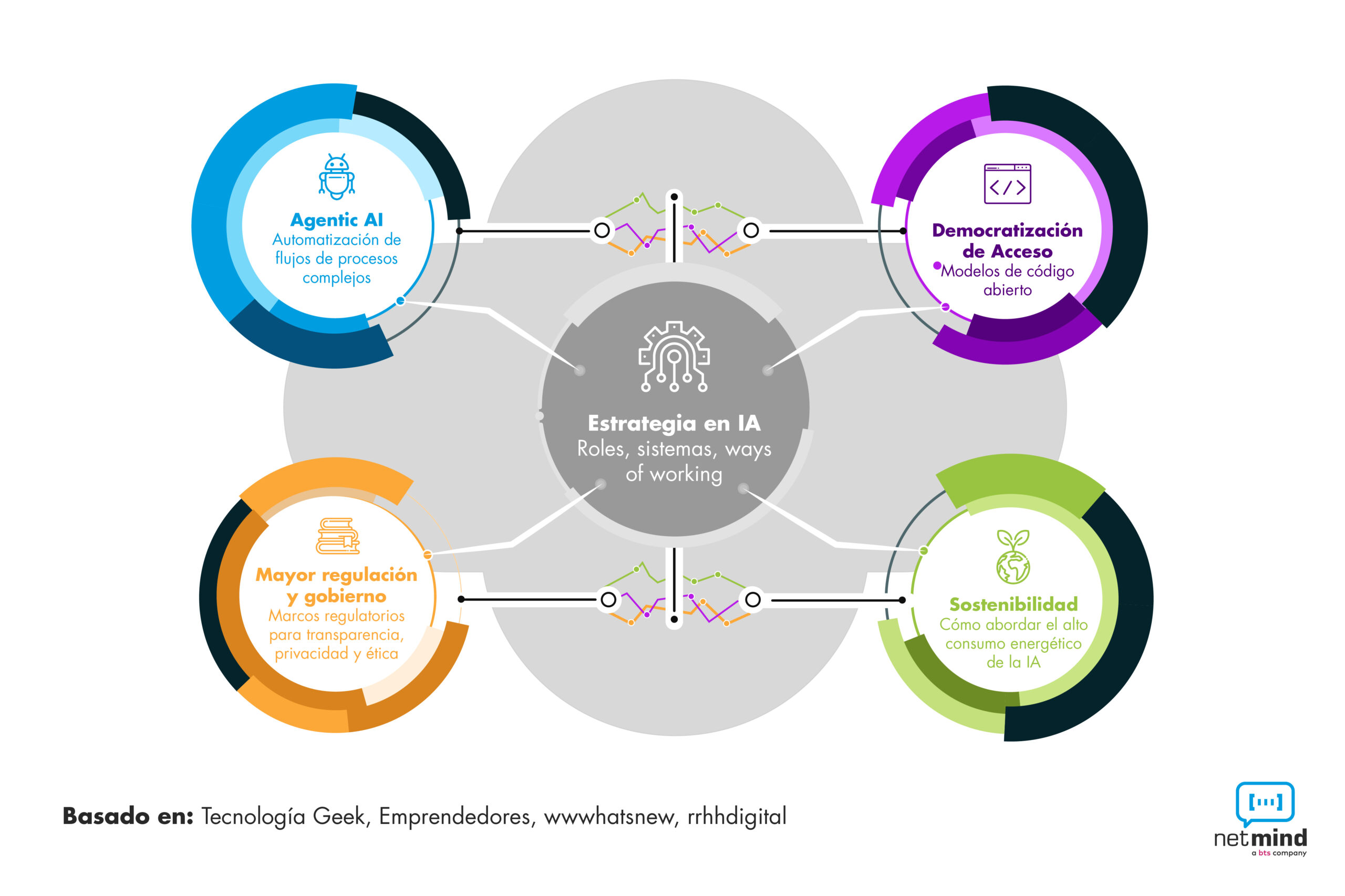
En esta imagen describimos en formato de infografía las 5 principales tendencias de IA generativa para este 2025

1.  Formalizing a GenAI Strategy

The first step in harnessing the potential of GenAI’s potential is defining a clear strategy aligned with business objectives. Many organizations face the challenge of translating technological innovation into tangible results. This requires:

  • Identifying Key Use Cases: From customer support to product personalization, the opportunities are broad. All business areas can benefit from GenAI.
  • Top-down and bottom-up alignment: It is crucial to involve senior leadership, middle management, and operational teams. Leaders must ensure strategic alignment, while teams need training, tools to execute the vision, and room to experiment. The challenge is scaling individual improvements to drive progress across teams and the organization.
  • Taking a holistic view: The strategy should cover at least five major areas: 
    • Maximizing business value
    • Introducing new ways of working to embed AI
    • Addressing people to accelerate adoption, talent, and culture
    • Strengthening technology platforms and systems
    • Ensuring the use, quality, and security of data
    • Applying Governance and legal compliance
  • Impact measurement: Establishing specific KPIs to evaluate the success of GenAI initiatives, such as improvements in operational efficiency or increased customer satisfaction.
  • Adaptability: The short history of GenAI is showing us that things change faster than in any previous disruption. An agile mindset, translated into new ways of working focused on maximizing learning is essential in this context.

A well-defined strategy not only provides a clear path to adoption, but also reduces the risk of losing direction in an constantly changing technological environment.  GenAI cannot scale without a solid foundation of skills, culture, and leadership.
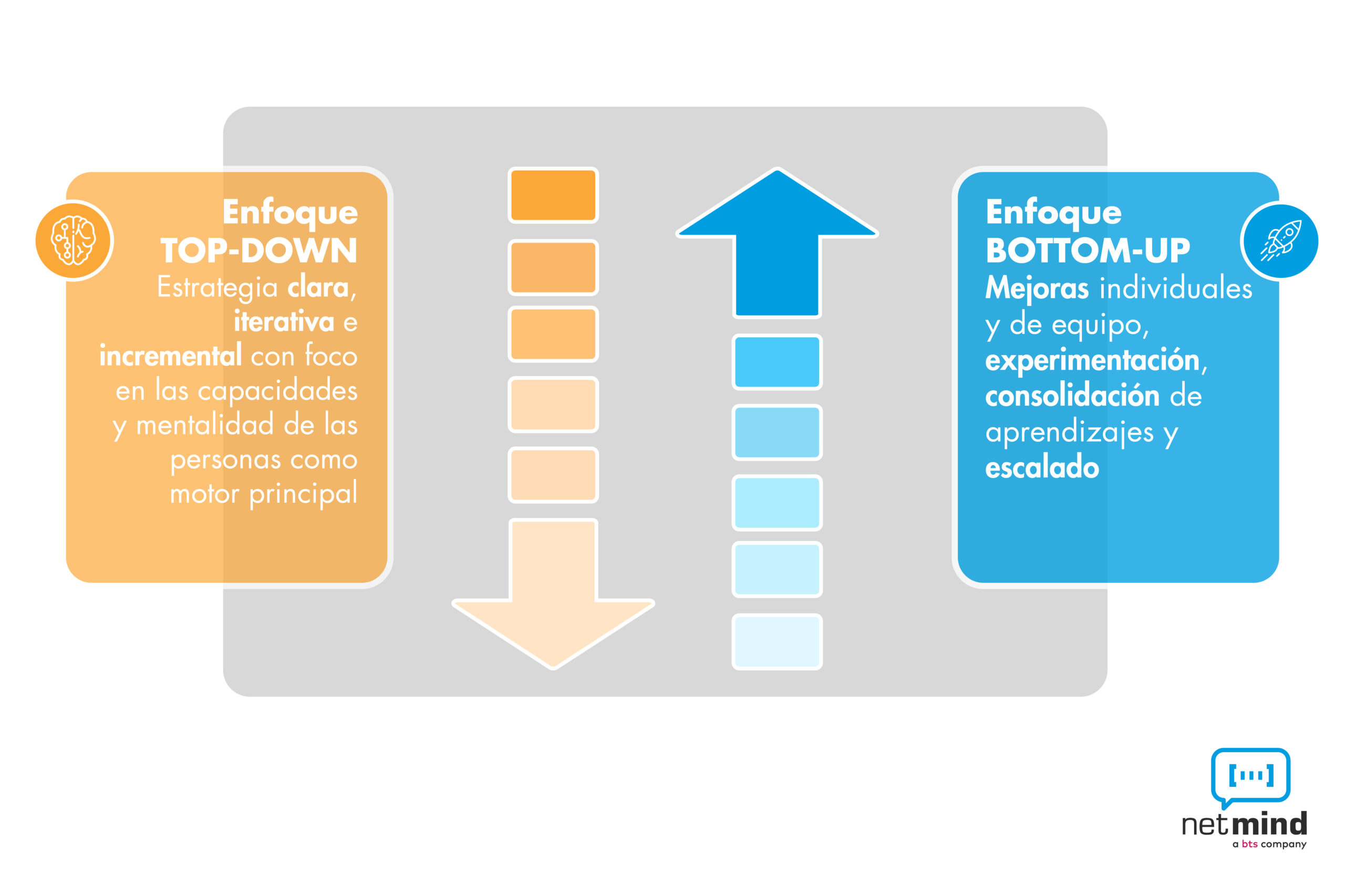
 
Esquema del modelo up-down de adopción de IA creado por Netmind en su PoV de IA

2. Automating Complex Process Flows (Agentic AI)

Agentic Artificial Intelligence (Agentic AI) refers to artificial intelligence systems with a high degree of autonomy. These systems do not simply react to predefined commands (prompts); they also act proactively, anticipating needs and executing complex tasks without constant human intervention. Their ability to plan actions, make decisions, and learn from experience makes them a key tool for transforming organizational operations in areas such as:

  • Advanced automation: For example, using generative chatbots capable of managing personalized customer interactions, optimizing the time of human teams.
  • Simulations and predictive analysis: GenAI’s ability to simulate complex scenarios and provide real-time solutions is transforming sectors such as logistics, healthcare, and finance.
  • Optimization of human capital: Companies can free teams from repetitive tasks, enabling them to focus on strategic activities.

Agentic AI is not just about doing things faster, but about enabling smarter, data-driven decision-making. One of its most distinctive features is the ability to act before an obvious need arises. For example:

  • In finance: An Agentic AI system not only identifies risk patterns, but also acts autonomously, such as rebalancing investment portfolios in real time or adjusting a trading strategy based on market conditions detected independently.
  • In the customer experience: An agentic virtual assistant could not only anticipate user needs, but also act proactively to offer personalized solutions, for example, automatically scheduling product maintenance based on collected data and detected behaviors, without customer intervention.

Despite the clear benefits, implementation raises questions due to the current cost of these solutions and fundamental elements such as the reliability they generate, potential bias, and the lack of transparency and explainability. At the same time, the impact on employment and organizational management is enormous. 


3. Democratizing Access

Historically, access to advanced technologies like GenAI has been limited to large corporations with significant resources. In the case of GenAI, closed-source large language models (LLMs), such as OpenAI’s GPT, often involve substantial costs due to licensing or subscription requirements. These expenses can be prohibitive for small and medium-sized businesses seeking to adopt GenAI solutions.

However, this is changing rapidly thanks to initiatives such as:

  • Open source models: In the first weeks of 2025, the emergence of DeepSeek, a new open-source LLM model, has revolutionized the IAG ecosystem worldwide. It was developed in record time and at a much lower cost than other models. Meanwhile, the Spanish government has launched “Alia,” the first foundational AI model in Spanish, representing a milestone in democratizing access. In addition, models such as Meta’s LlaMA offer a more accessible alternative by removing licensing costs. This openness allows developers and organizations to customize and adapt models to their specific needs, fostering innovation and lowering barriers to entry.
  • Specialized tools: Beyond language models, there are specialized GenAI tools that make professional access to a wide range of functions easier.
    • Written content generation: Tools like Jasper and Writesonic enable companies to create high-quality texts for blogs, social media, and marketing, optimizing the time and resources dedicated to content creation.
    • Graphic design and image creation: Platforms like Canva, which integrate AI features, allow users without design experience to create professional graphics.
    • Customer service automation: Applications like Tidio use AI to manage customer interactions, improving efficiency and customer satisfaction.

These specialized tools allow companies to choose solutions aligned with their specific needs, whether to generate creative content, optimize administrative processes, or improve customer experience in particular sectors.

  • Training and digital literacy: Democratizing AI is not only about tools; it also means training teams so they can use them effectively.

Democratization will level the playing field, enabling small and medium-sized companies to play a leading role in the AI era as well.

4. Regulation and Governance

As GenAI becomes more prominent, concerns around ethics, privacy, and security are also increasing. The European Union has taken a step forward with the AI Act, a pioneering piece of legislation designed to establish clear frameworks for the responsible development and use of AI. Key points include:

  • Risk classification: The AI Act defines risk categories for AI applications, from minimal to unacceptable, regulating their use based on potential impact.
  • Transparency and explainability: Organizations will need to ensure that their GenAI systems are understandable and free from bias.
  • Data protection: Strengthening user privacy and ensuring that AI applications comply with data protection regulations such as the GDPR.

For companies, complying with these regulations is not only a legal obligation, it is also an opportunity to build trust with customers and stakeholders. The foundation for achieving this is encouraging ethical, responsible, and transparent use by people.

5. Focus on Sustainability

AI’s exponential growth also presents a significant challenge: its environmental impact. Generative AI models, especially the largest ones, require massive amounts of energy to train and use, although new approaches like DeepSeek are showing that lower energy consumption is possible.

Organizations, for their part, are adopting strategies to mitigate this impact, such as:

  • Use of renewable energy: Technology companies are investing in infrastructure that runs on clean energy sources.
  • Model optimization: Reducing model size and making models more efficient without compromising performance.
  • Green initiatives: Promoting sustainable practices across the entire value chain, from development through to AI solution deployment.

Sustainability is not only an ethical issue, it is a competitive advantage in a world where consumers and regulators demand a clear commitment to the environment.

Conclusion

GenAI is ushering in a new era for companies, full of opportunities and challenges. From formalizing clear strategies to addressing ethical and sustainability issues, organizations are facing an inevitable revolution.

The question is not whether you should adopt GenAI, but whether you are ready to do so strategically, with agility, sustainably, and aligned with your company’s values. Are you ready to ride this wave of transformation?

Take Your Projects to the Next Level!

AI can transform your business, but you need the right strategy. Our team of experts is ready to help you.

Formación

  • Sensibilización en la importancia de las e-Competences
  • Capacitación Técnica y en Gestión de la Tecnología
  • Formación a medida
  • Adaptación de contenidos propios a formación presencial y online

CONTACT US

Netmind España
Barcelona +34 933 041 720
Madrid +34 914 427 703

Nos puedes encontrar de:
Lunes – Viernes, 9:00-18:00 (GMT+1)

¡Te ayudamos!
info@netmind.net

¿Dudas sobre servicios/formaciones?
comercial@netmind.net

Search

Request Information

Request Information