We all use Computational Thinking on a daily basis, probably without even realizing it, and not always in the most efficient way. By the end of this article, you will not only understand the importance of training and mastering this strategic capability, but you will also be wearing the Computational Thinking glasses yourself.
The context of continuous digital transformation demands a culture of fast, constant learning and adaptation, supported by a spirit of experimentation and the ability to persevere until the best solution is found. Rather than focusing solely on improving digital and technical skills, Computational Thinking strengthens the essential cognitive and transversal skills required to tackle professional and personal challenges, technical and non-technical, simple or highly complex.
Taking as an example one of the complex challenges we face as a global society, understanding and adopting AI at all levels. Computational Thinking knowledge becomes a powerful ally, providing the structured understanding needed to interact effectively with AI systems.
Let’s Start with the Basics: What Is Computational Thinking?
Computational Thinking is the human ability to solve problems and express ideas by leveraging the potential of computer science.
It is the set of soft skills that underpins everything digital and make it work so effectively. Take the example of a software developer. This role clearly requires the hard skill of programming languages (Python, Java, etc.). But a strong developer complements this knowledge with a set of soft skills that are part of Computational Thinking, which we will explore below. These skills help them solve problems or build solutions more effectively. And an important note: not all technical profiles master Computational Thinking. Anyone can develop it without having technical knowledge, and it significantly lowers the barrier to understanding how technology works.
Computational Thinking is a movement for change, a liberating way of thinking that removes noise, provides focus and capability, and is empowering because it gives autonomy and helps us understand the technology-driven world around us.
What Is It NOT?
As we often repeat in our Computational Thinking courses: it is not thinking like a computer, it is not programming or using programming languages, it is not the same as artificial intelligence, it does not require years of study, and it is not difficult to develop.
If you want to learn how to program and continue your Computational Thinking training, you will of course reach that technical level, and writing lines of code can be very rewarding. But this is not the goal for most non-technical profiles. What they do need is not to be mere users of technology, but to understand what lies beneath it and even to be able to develop solutions using no-code approaches. This is where the emerging citizen developer movement comes in, a movement that seeks to empower everyone to create technology. In other words, enabling people without programming knowledge or experience to actively participate in building solutions, using low-code or no-code tools, feeding the system with the collective potential of all profiles.
Why Does It Matter and What Is It For?
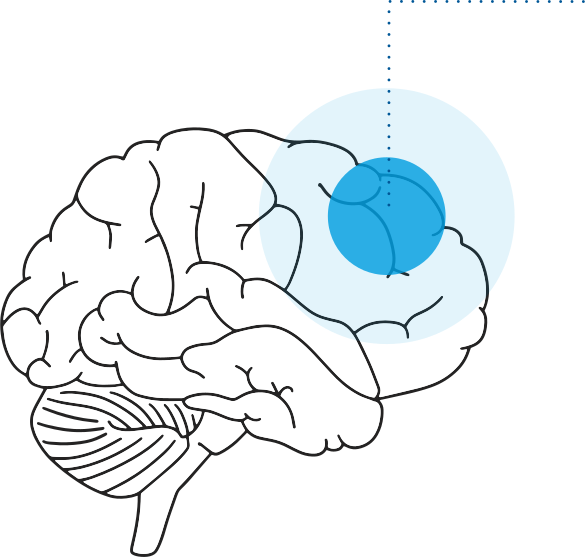
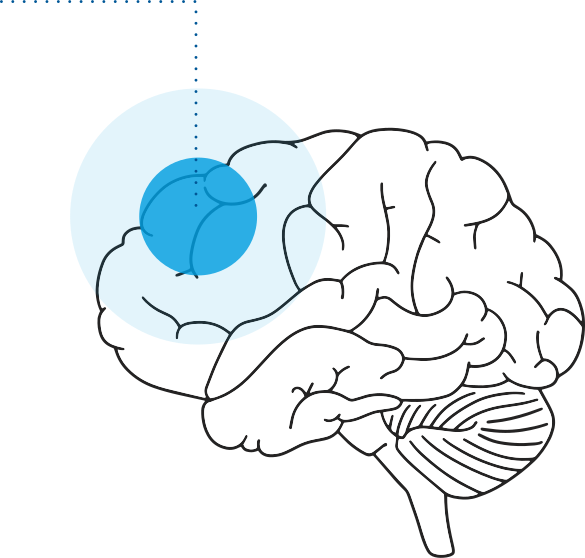
We naturally absorb and store large amounts of information—noise—in our daily lives. Our minds cope, but often become overloaded and blocked. We act impulsively and skip the analysis phase because we generally feel we don’t have time to think. We end up multitasking, unfocused, unable to flip the switch to System 2 thinking.
Let’s pause for a moment to look at the two thinking systems that operate within all of us:
The alarming part comes with the data: System 1 is responsible for 97% of the decisions we make each day. System 2, therefore, accounts for just 3%. And this goes far beyond simple or repetitive tasks, we rely on System 1 for almost all our activity. Why? Once again, because of overload and excess noise.
Our brain, always an ally, adapts to this high energy demand by keeping us on autopilot for survival. This is where Computational Thinking plays a key role: helping to clear the noise, rebalance the two systems, create space and clarity, and gradually make it easier, and less energy-intensive, to activate the valuable System 2 switch.
Why Does This Suddenly Sound Like Mindfulness?
Although they may come from very different worlds, Computational Thinking and mindfulness share a fundamental element for well-being: developing the ability to remove mental noise, focus on what truly matters, think in a more structured and organized way, and counteract mental chaos. This enables better decision-making, and, more importantly, helps us feel calmer and happier.
Is This Something New?
Not at all. In fact, Computational Thinking has just come of age this year marks 18 years since the first research paper on the topic was published in 2006. Like any psycho-pedagogical construct or cognitive skill, it has matured. Today, it is mandatory across all stages of the educational curriculum in every autonomous region of Spain.
It spans subjects such as Environmental Studies, Mathematics, Biology and Geology, Technology, to name just a few. As a transversal skill, it permeates everything. Our children—and not-so-children—are and will be natural experts in Computational Thinking. And we are not just talking about digital natives, but about their future ability to deeply and intuitively understand how machines work, not just how to use them. By extrapolating this computational knowledge to any field they choose, they will be able to tackle all kinds of challenges, from personal to technological.
Sounds great, but how do you actually achieve this?
Now you feel like getting started, right?
Computational Thinking is a macro skill based on four fundamental abilities that we all naturally possess and already use in our professional and personal lives, but rarely stop to reflect on. This discipline doesn’t give you one new lens, but four new prisms, perspectives and angles, from which to observe and analyze challenges.
It is about identifying when each skill is at play, reflecting on them, understanding which ones come more naturally to us and which don’t, training them, and developing the judgment needed to decide when to activate each one, switch between them, or combine several at once depending on the challenge.
They are: Abstraction, Decomposition, Pattern Recognition, and Algorithm Design.
Step back from what you’re doing for a moment. Observe the problem from a distance, take in the full picture, visualize its parts, and reflect. Abstraction allows us to gain perspectiveand a global view, ask the right questions, eliminate noise and irrelevance, focus on what truly matters, reduce complexity, build strategy, and check whether we’re still heading in the right direction, or have drifted off course. Remember to zoom out several times a day, in different situations.
You understand perfectly how the Madrid Metro works because you have the map in your head, right? A map is the best example of abstraction.
In computer science, abstraction is a way of reducing complexity and enable more efficient design and implementation ofcomplex software systems.
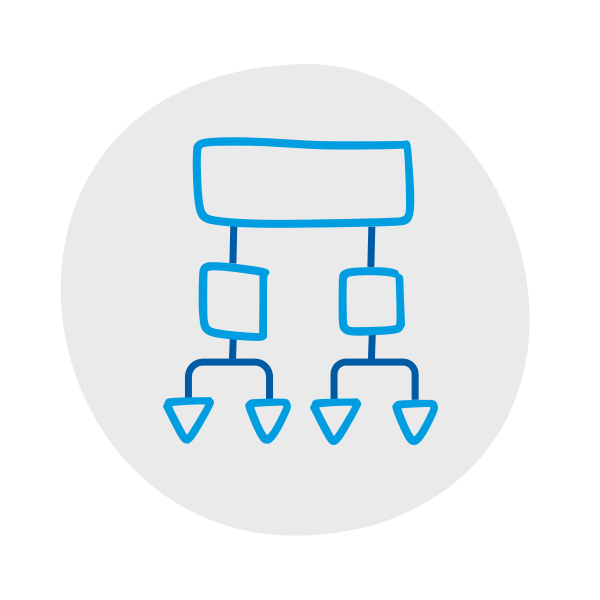
Once the complex problem has been understood, analyzed, and prioritized, break it down into smaller, manageable pieces. Make it tangible, classify it. Move from analysis to action. Dive into the details and execute the tasks.
The most recognizable example is your daily to-do list, but did you reflect on it first? Did you apply abstraction beforehand, or did you jump straight into execution?
In computer science, decomposition breaks a complex problem down untilits smallest parts are simple enough to be solved easily.
Our brains love patterns, it feels safe and comfortable relying on them. But beware of the biases they can create.
As explained earlier with System 2 thinking, active and intentional pattern recognition allows us to identify relationships and similarities between sub-problems, reuse successful solutions, improve memory retention, and save energy.
In computer science, pattern recognition is the process of assifying input data into objects, classes, or categories based on their main characteristics or recurring elements.
An algorithm is simply astep by step process, a recipe that guides us while cooking. Without it, we’d crack the egg into the pan before heating the oil.
Think about IKEA instruction manuals, we’re surrounded by algorithms, some better than others (which is why assembling the Kolbjörn shelf can feel like a nightmare). The ability to design clear, structured, and effective algorithms, action plans, is essential for effective communication, teaching tasks, planning, and delegation.
In computer science, algorithm design involves creating a step-by-step procedure or set of instructions that a computer follows to perform a task or solve a problem.
Can It Help in My Personal Life?
Absolutely. Identifying your thinking tendencies, are you more inclined toward abstraction and seeing the big picture, or toward decomposition and diving straight into details and execution?, provides valuable self-awareness. From there, you can work on strengthening the skills you use less. More than a powerful tool, Computational Thinking is a toolbox, where the most important skills is knowing which tool to use at each moment. What if you’ve been walking through life using only the power of decomposition, and doing pretty well, but could now add the other three superpowers?
Asking the right questions (abstraction) helps you better understand your loved ones and navigate complex situations. Helping a friend break down a major emotional problem into smaller, manageable pieces (decomposition), and creating a step-by-step action plan together (algorithm design), strengthens active listening. Realizing that two people aren’t understanding each other because one is operating in abstraction (“Why are we doing this?”) and the other in decomposition (“How do we do this and what needs to be done now?”) is incredibly powerful, it helps them understand one another.
Sometimes, we’re simply not speaking the same language without realizing it. Identifying the often-repeating reasons behind misunderstandings is pattern recognition at its finest.
Once you put on your Computational Thinking glasses, you won't be able to take them off!
Expand on what you already know by reading Computational Thinking: The Intelligence of Moving Fast, in the Right Direction.