
The uncertain world we live in
The acceleration of change and the increase in complexity are defining a business environment in which it is difficult to succeed, even for the most experienced organizations. Today’s companies are constantly striving to keep pace in areas such as sustainability, future readiness, and adaptation to technological advancements, among other challenges.
In the next decade, 50% of the companies in the S&P 500 index will be replaced by new ones. Likewise, when it comes to future challenges, 50% of employees say their organization is not prepared for what lies ahead. As if that were not enough, digital technology is disrupting entire industries. Since 2019, for example, the technology giant Apple has sold more watches annually than all Swiss watchmakers combined.
While digital transformation is one of the most visible symptoms of this rapidly evolving environment, there is an even greater challenge facing organizations today: the acceleration of change.
In recent years, organizations have used various terms to describe this phenomenon of continuous and accelerated change. You have likely heard references to terms such as VUCA (Volatile, Uncertain, Complex, Ambiguous), BANI (Brittle, Anxious, Nonlinear, Incomprehensible), or the Cynefin framework (Complex, Complicated, Chaotic, Clear).
Why so many acronyms? Complexity is a universal condition that increasingly makes it difficult to manage, anticipate, and understand what is happening. Similarly, acceleration makes it difficult even for the most prepared organizations to anticipate changes and respond in a timely and effective manner.
Regardless of the framework used to describe these challenges, if your organization plans not only to survive but to thrive in the future, its leaders must chart a path forward in which adaptation and agility are embedded in the DNA of the culture from how people are managed and developed to how technology is conceived and used. This may sound overwhelming. While many leading organizations have already embraced this new reality and are adapting quickly, the good news is that there is still time to transform your own organization.
To begin, it is essential to understand the six key challenges your organization must overcome to thrive at the pace of an evolving world.
Managing a large number of interacting elements.
.- Addressing nonlinear interactions, where small changes produce consequences with enormous impact.
- Engaging with dynamic change, where the whole is greater than the sum of its parts, and solutions cannot be imposed but must emerge from the circumstances.
- Accepting that evolution is irreversible. The system has a history, the past integrates with the present, elements evolve with each other and with the environment, and this evolution cannot be reversed.
- Managing in the midst of constant change. Although complex systems may appear ordered and predictable in hindsight, looking back does not help predict the future, as conditions and external systems continuously evolve.
Navigating a complex system in which agents and the system constrain each other, especially over time. This means it is impossible to foresee or predict what will happen next.
Thriving in the new environment
So, what does it take to address these six challenges? Organizations must be able to adapt quickly to the challenges posed by changing market conditions. These may result from emerging technologies or new economic conditions. How can they do this? By modifying their capabilities, mindsets, organizational structure, and ways of working..
This approach is known as Adaptive Organizations.
What do adaptive organizations look like?
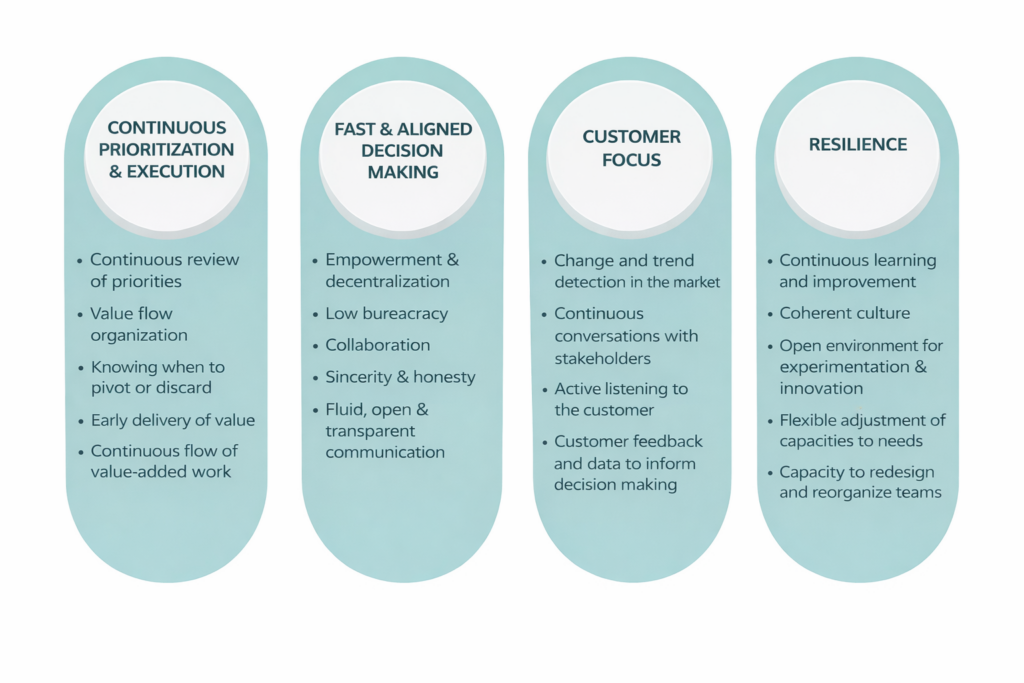
There are four key characteristics that define them:
Continuous prioritization and execution
Prioritization is essential to align and focus the organization’s efforts and investments. It enables leaders to dedicate their time to actions with the highest impact and value. But prioritization cannot exist in a vacuum it has no impact without strong execution. Organizational efforts must always result in outcomes delivered to users and customers.
Thoughtful and strategic prioritization enables organizations to deliver a continuous, uninterrupted flow of customer value. As a result, organizations generate a constant flow of customer data that can be used to identify changes and emerging trends, define response options, and prioritize actions to create focus. This capability to review data, extract insights, and use them to decide when to persist, pivot, stop, or pause is critical for progress.
- Fast and aligned decision-making
When unexpected challenges arise, what distinguishes leading organizations is fast and aligned decision-making. Organizations have established mechanisms such as decentralized decision-making and increased transparency to ensure faster and more fluid governance, avoiding misalignment and deviations. In every decision, all organizational efforts are focused on what delivers the greatest value to customers and users.
- Customer focus
Customers are the reason organizations exist. Ultimately, the customer is the judge that determines an organization’s success or failure. Deep market knowledge and customer understanding are the foundation of any strategy. Organizations must practice active listening to understand customer needs and challenges, gather feedback, and define the priorities that will drive their progress in the market.
- Resilience
Organizations must not only withstand change, but ride its waves. Resilience and flexibility are part of the DNA of organizations that will thrive in the future. Instead of working in silos, adaptive organizations use more fluid alternative structures that allow resilience to scale. These same organizations invest decisively in developing learning capabilities that generate and capture new knowledge. The accumulated experience of employees and high-performing teams adds enormous value, facilitating the necessary evolution of the organization.
How do Adaptive Organizations operate?
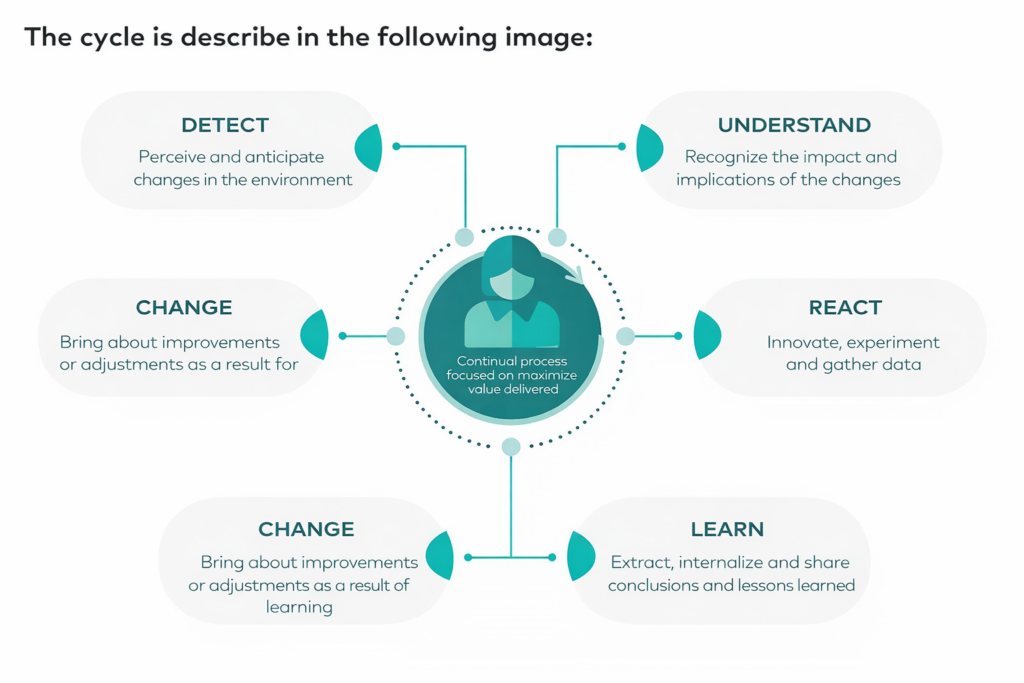
Adaptive Organizations place the customer above everything else. To make decisions and move the business forward in rapidly changing conditions, they use a continuous and iterative five-step cycle centered around the customer:
- Detect. Adaptive Organizations have the ability to sense and anticipate changes in their environment. Organizational leaders maintain an open mindset, detecting and observing evolving market conditions.
- Understand. Adaptive Organizations recognize the impact and implications of the changes they detect, understanding and anticipating their consequences.
- React. Adaptive Organizations have mechanisms that allow them to act on what they detect and understand by imagining innovative solutions, building experiments, and collecting data to generate new learning.
- Learn. Adaptive Organizations follow a continuous learning process that extracts, internalizes, and shares insights and lessons learned across the organization.
- Change. Adaptive Organizations implement improvements and adjustments to processes that make them more efficient, customer-centric, and people-oriented.
Becoming an Adaptive Organization
It is clear that becoming an Adaptive Organization is the ultimate goal, even if it may sound challenging. How can it be achieved? The first step is to understand where the organization stands today. Key questions include:
- What is the starting point?
- What are the main challenges?
- Which challenges should be addressed first?
Once these questions are answered, a roadmap for change can be developed. To do this, organizations must ask: what should be prioritized? Then, they must begin working toward this new reality as soon as possible.
Becoming an Adaptive Organization is not a one-time project with a beginning, middle, and end. It is about continuously responding to the volatile environment in which the organization operates. That is why it is essential to start as soon as possible: it is an ongoing process, a journey without end. The competencies and capabilities that enable an organization to continuously adapt to a changing environment, remove systemic constraints, and optimize the entire organization are referred to as Business Agility. It represents the latest stage in the evolution of Agile, which originally emerged to improve the way teams work.
However, Business Agility is not the same as Agile. Agile is a set of techniques and practices designed to foster rapid value delivery, based on the values and principles of the Agile Manifesto. Agile is a “how,” not a “why.” While Agile evolved to scale techniques and practices from teams to programs and larger structures, Business Agility extends the benefits of Agile mindset and principles across the entire organization.
As organizations work to drive change, they will not have all the answers, but they will move quickly from ideas to action. The resulting transformation may be broad or focused on specific areas—it varies for each organization. Once it begins, each step brings the organization closer to becoming an Adaptive Organization.
Throughout the journey toward becoming an Adaptive Organization, ensuring success requires addressing the nine organizational dimensions. These are where change must be focused and where its effects materialize. Without addressing them, it is impossible to create lasting transformation. Organizations often focus on only some of these dimensions and then wonder why their efforts fail.
The following diagram highlights the nine dimensions:
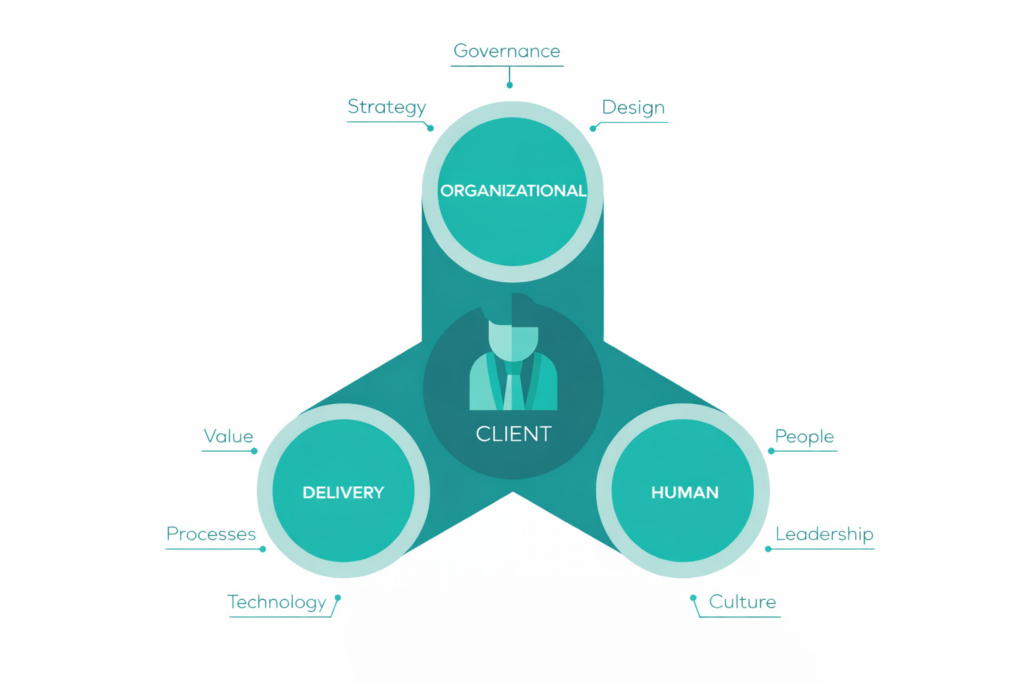
For example, addressing only the human aspect will not work if processes and technology are not aligned. Similarly, if change is not part of strategy definition and execution, the organization will not be able to fully and successfully adopt new ways of working. True transformation requires a systemic approach. Organizations must ask: how will change impact each dimension? And then define a path that addresses change across all of them.
Each organization’s journey is different, as the changes required in each dimension will vary. This process is not easy, and in some cases, engaging an external partner can be a decisive step, providing an outside perspective and expert guidance to introduce the new approach more quickly and effectively and integrate it into the organization’s way of working.
The right external partner can guide the design of the new organizational model and processes, work with employees to drive and adopt the transformation, and help refine the processes, structures, and hierarchies needed to sustain change. In a transformation of this magnitude, support that truly understands culture, people, and ways of working can be the foundation for successfully executing the transformation.
The S-Curve Journey to Becoming an Adaptive Organization
The path to becoming an Adaptive Organization can be visualized as an “S-curve” a progressive journey that represents the evolution of an organization’s fluency in agile practices. This journey is not linear; it reflects the gradual growth of capabilities and the expansion of agile principles from individual teams to the entire enterprise.
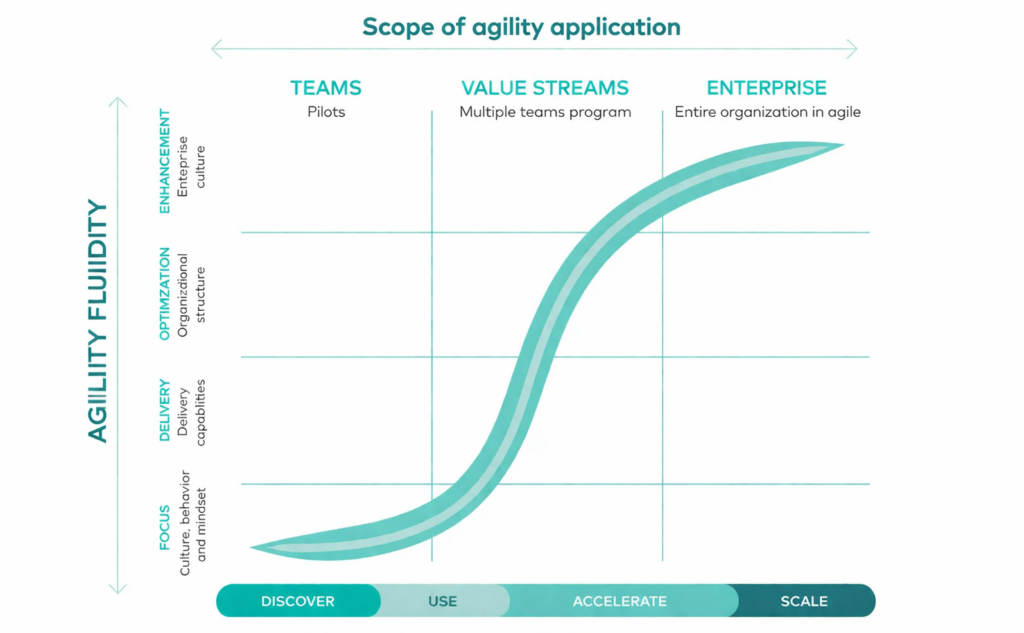
The S-curve is characterized by key inflection points where mindset shifts, the adoption of innovative practices, and customer orientation lead to transformational leaps.
At the beginning of this journey, early successes with foundational practices that improve team-level agility create the momentum needed to scale Agile across all departments and, ultimately, across the entire organizational ecosystem.
As the journey progresses, traditional boundaries between departments and functions begin to blur, replaced by value streams supported by a dynamic network of empowered, cross-functional teams aligned around shared objectives. The result is an organization that moves with precision and purpose, responding quickly to new opportunities and challenges in a fluid and unpredictable environment.
Start your transformation
It is time to step boldly into the future. The world will not wait; the pace of change will not slow down. The path your organization chooses today will define its success tomorrow. The power to transform change into opportunity and complexity into competitive advantage is within your reach.
Embark on the journey to become an Adaptive Organization. Let Business Agility be the compass that guides your organization toward new horizons. Every step you take is a leap toward resilience, every shift a move toward innovation, and every milestone a reinforcement of your commitment to adaptability.
Start the transformation. Take the leap. Become an Adaptive Organization.