
The speed at which technology is evolving is redefining the talent model within organizations. What works today may become obsolete in a matter of months. In this context, upskilling and reskilling are no longer merely training initiatives; they have become strategic decisions that require methodology, vision, and expert guidance.
But there is a decisive nuance: artificial intelligence is not only transforming business models. It is also redefining how we learn. Designing learning pathways aligned with business needs, measuring real impact, and ensuring transfer to the workplace are all possible with a strategic partner like Netmind, which guides and supports organizations throughout the entire talent transformation process.
In this context, being part of the Leading Learning Partners Association (LLPA) enables us to connect our expertise in talent transformation with an international network of learning partners specialized in technology. This collaboration strengthens our ability to design upskilling and reskilling journeys aligned with official certifications, leading technologies, and real business needs.
The key to surviving technological disruption
Imagine this scene.
A company spends years investing in the optimization of its technology infrastructure. It consolidates teams, trains specialists, and implements tools. Everything works. The results follow.
And then, in less than 18 months, the market changes.
Cloud becomes the standard. Automation redefines processes. Artificial intelligence enters key operations. New competitors are digital from day one.
What was once a differentiator is now simply the minimum requirement.
This is not an exception. It is the context in which organizations operate today.
Disruption is no longer occasional
For a long time, technological transformations were periodic processes. Companies planned major updates every few years and had time to adapt.
That scenario has disappeared.
Today, technological evolution is continuous. Architectures, tools, and methodologies change rapidly. Operating models are being constantly redefined. Organizations must adjust their capabilities while continuing to operate.
This implies something fundamental: talent management can no longer be based on stable knowledge. Skills need to evolve at the pace of the business.
The challenge is not to incorporate technology, but to ensure that people can work effectively with it.
When knowledge is no longer enough
A decade ago, mastering a specific technology could guarantee professional stability for years. Today, that same knowledge can lose relevance in a very short period of time.
Not because it is no longer valid, but because the environment demands new combinations of skills.
Companies that understand this shift stop treating training as a one-off event and start integrating it into their strategy. It is not about reacting to every new development, but about anticipating which capabilities will be needed and preparing the organization to adopt them.
At this point, the focus shifts from “what we know” to “how we evolve.”
This is where two key levers come into play: upskilling and reskilling.
Artificial intelligence as a catalyst for learning
There is an additional element accelerating this change: AI not only demands new skills, it also transforms the way they are acquired.
Today, learning can be integrated into the flow of work: intelligent assistants that offer real-time recommendations, dynamic simulations, virtual labs, or systems that provide immediate feedback.
Learning is no longer separate from work. It becomes part of the work itself.
This creates a strategic opportunity: not only to train faster, but to learn continuously, contextually, and practically. Organizations that integrate this dimension do not just develop technical skills; they develop adaptive capacity.
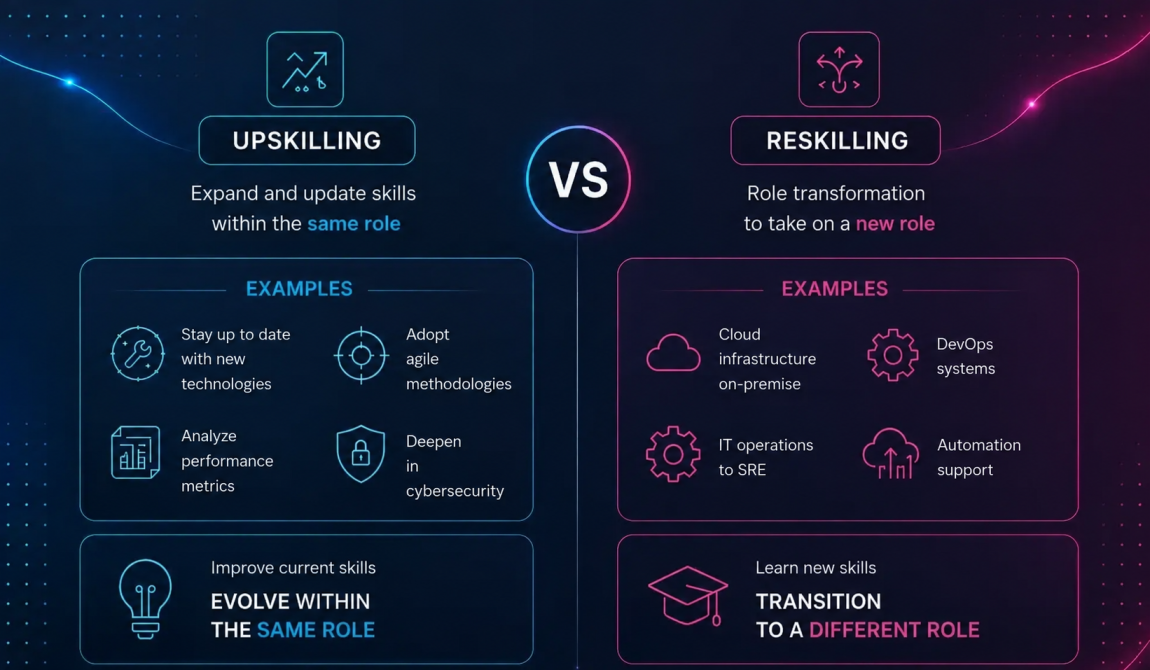
Upskilling vs Reskilling: Strategic decisions
Although they are often mentioned together, they respond to different needs.
Upskilling means updating and expanding skills within the same role.
It is about deepening capabilities in order to adapt.
For example:
- A developer who incorporates cloud-native practices.
- A network specialist who broadens their knowledge of cybersecurity.
- A project manager who adopts agile methodologies.
The role remains the same, but its requirements evolve.
Reskilling, on the other hand, means preparing professionals to perform different roles.
It is about redirecting internal talent toward new strategic areas.
In IT environments:
- On-premise administrators evolving into cloud specialists.
- Systems technicians developing DevOps skills.
- Traditional analysts moving into data or artificial intelligence.
Reskilling enables organizations to accelerate transformation by reducing dependence on the external market and leveraging the experience already accumulated within the organization.
The key lies in deciding which combination the business needs according to its technology roadmap.
The readiness gap: The silent risk
Many organizations recognize the need to evolve their capabilities, but few are truly prepared to do so with a structured method.
This is where what we might call a readiness gap emerges.
It is not just a skills gap. It is the distance between:
- The strategic ambition of the business
- And the real ability of people and the organization to execute it
When this gap is not managed, the risks are clear:
- Underused technology implementations
- Excessive dependence on external providers
- Operational friction
- Loss of competitiveness against more agile competitors
Investing in technology without investing in organizational readiness is an incomplete strategy.
The most common mistake: Training without direction
Many organizations invest in training but do not achieve proportional results. The problem usually lies in the approach.
Common warning signs include:
- Reactive training initiatives.
- Disconnected programs.
- Lack of prior diagnosis.
- Limited measurement of real impact.
When training becomes an accumulation of courses, it rarely generates transformation.
For learning to have an impact, it must be linked to a clear strategy and connected to real operational challenges.
.
Culture and Leadership: The invisible foundation of transformation
Talent transformation is not only technical; it is cultural.
For upskilling and reskilling to work, leadership must:
- Define a clear vision of where the organization is heading
- Communicate why change is necessary
- Create a safe environment for experimentation and learning
When teams perceive that learning is part of the work model (and not a one-off requirement), adoption accelerates.
Leadership also plays a decisive role in integrating AI responsibly and strategically: not as a replacement for talent, but as an ally to amplify capabilities.
Without this cultural dimension, even the best training initiatives lose impact.
How to design an effective strategy
A solid upskilling and reskilling strategy starts with a simple yet strategic question:
What technical, organizational, and cultural capabilities will we need to execute our roadmap in the coming years?
Answering it involves more than planning training. It means designing a talent evolution model that is aligned with the business and prepared for a changing environment.
From there, the process can be structured around five pillars:
- Gap diagnosis and readiness level
Identify not only the distance between current and required skills, but also the organization’s level of readiness to embrace change. - Structured and progressive pathways
Design coherent journeys that connect current skills with future roles, avoiding isolated actions with no continuity. - Learning integrated into work
Incorporate applied practice (labs, simulations, real projects) and leverage tools that facilitate feedback and learning within the flow of operations. - Active support and leadership
Promote mentoring, collaborative spaces, and a culture that legitimizes continuous learning as part of professional performance. - Measurement linked to business outcomes
Evaluate impact on efficiency, quality, innovation, and adaptability, ensuring that talent development drives strategic objectives.
Without this comprehensive vision, learning risks remaining a tactical initiative. With it, it becomes a driver of sustained transformation.
Preparing is not optional
Transformation is not a destination; it is a continuous process. And like any process, it requires direction, method, and resolve.
Organizations that plan how to evolve their talent not only reduce risks: they gain clarity, focus, and execution capability.
Change will continue to happen.
The difference will lie in who is prepared.
That is where the future is defined.
Take the next step in your talent strategy
If your organization is undergoing a technological transformation process and needs to align talent and strategy, we can help you design a development model tailored to your goals and operational context.
“The Future Is Not Improvised: It Is Built.”