1. Transformation does not start with technology. It starts with talent.
The accelerated pace of change and the increasing level of complexity have shaped a highly demanding business environment. Even the most capable organizations find it difficult to maintain their position.
Today, companies are working to simultaneously advance in sustainability, technological innovation, and future readiness. It is estimated that in the next decade, 50% of the companies currently listed in the S&P 500 will be replaced by new organizations. In addition, half of professionals believe their company is not sufficiently prepared to face upcoming challenges.
Digital technology continues to transform entire industries. Since 2019, Apple has sold more watches annually than all Swiss manufacturers combined. However, while digital transformation is the most visible manifestation of this new environment, the real challenge lies in the speed at which it evolves.
Organizations must not only adapt to change, but also learn to anticipate and lead it if they want to remain competitive.
In recent years, the focus has evolved from process agility and continuous learning toward the development of digital capabilities directly connected to business strategic challenges. The priority is no longer just to implement technology, but to develop talent and align it with the organization’s real needs.
As IT incorporates new solutions—sometimes in an unstructured way—it becomes essential to identify and develop the key technological talent required for success. This requires building a clear and shared narrative around the capabilities needed.
It is necessary to evolve from a process-centric approach to a people-centric one. In the face of the rapid emergence of new technologies, the priority must be to develop and empower talent: what we call People-Based Digital Transformation.
This approach focuses on identifying, enhancing, and mobilizing individual capabilities. While processes are essential to standardize technology adoption, the true engine of innovation and adaptation is human talent.
Guided by a forward-looking strategic vision, organizations must strengthen their digital capabilities not only to react to change, but to lead it. Keeping people engaged and placing them at the center of innovation is key to ensuring transformation is sustainable and delivers real impact.
By embedding adaptability and agility at the core of their culture, organizations can turn uncertainty into opportunity and position themselves strongly in the digital revolution.
2. Addressing the challenge
On their path to digital transformation, organizations face multiple challenges that can slow down their progress. Overcoming them requires a holistic approach that combines technology with a deep understanding of human dynamics.
It is no longer enough for IT to be aligned with the business. In the digital enterprise, truly cross-functional teams are required.
IT professionals must deeply understand the strategic priorities of the business. At the same time, business leaders must develop advanced digital capabilities and collaborate effectively with technology experts.
Below, we highlight the key challenges that must be addressed to unlock the full potential of digital transformation.
Transform organizational culture through people: For a digital strategy to be successfully implemented, cultural change is essential. The challenge lies in transforming mindsets and behaviors at all levels of the organization, enabling people to adopt new ways of working and creating value.
Align the digital strategy with business objectives: Many organizations have digital initiatives, but they are not always fully connected to their strategic objectives. It is essential to design a clear, coherent digital strategy that is fully integrated into the corporate strategy and operational practices.
Empower the CIO as a transformation agent: The CIO plays a critical role in digital transformation, although this role is not always clearly defined or supported. It is necessary to strengthen their ability to act as a change agent, balancing people and technology to drive effective transformation.
Personalize strategy execution: The principle of “making the strategy personal” involves adapting its deployment to different roles and responsibilities. Each professional must understand what the strategy means in their day-to-day work and how they contribute to organizational objectives.
3. Thriving in the new environment
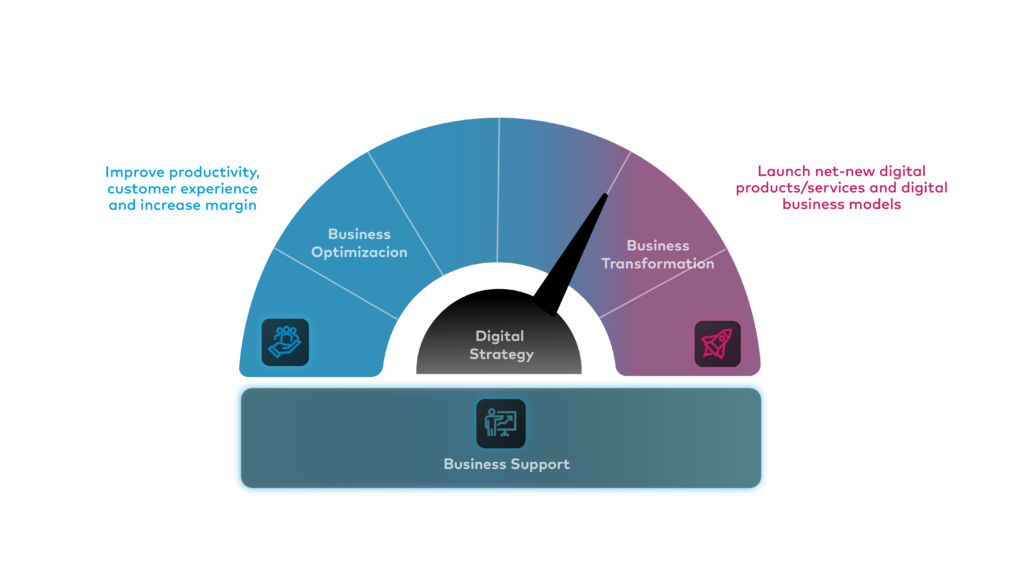
In the current context, organizations must first ensure operational continuity and system stability, using resources as efficiently as possible. This foundation is non-negotiable.
Once secured, they can allocate resources to optimizing current operations through technological advancements and transforming the business through new digital applications.
The allocation of resources between optimization and transformation largely depends on the company’s overall strategy. This acts as a compass to balance investments based on dynamic factors such as market conditions, competitive pressure, and internal needs.
This approach may vary over time and across different areas of the organization, enabling the agility required to adapt to a changing environment.
Ultimately, a well-defined strategy enables informed decision-making on how to leverage technology to drive growth and sustain competitive advantage.
3.1. Driving the business by improving IT efficiency: how to make it possible
3.1.1. Improve team efficiency and productivity
To increase the efficiency and productivity of IT teams, it is necessary to optimize solution development and manage demand more effectively. This involves adopting agile methodologies, continuously improving processes, and accelerating delivery without compromising quality.
Continuous training and proper support ensure that teams work aligned with best practices and up-to-date tools, fostering a user-centric approach.
3.1.2. Optimize services and customer satisfaction
Service optimization and improved customer satisfaction are achieved through efficient management of infrastructure and technical support. Simplifying operations, reducing costs, and providing agile support ensure reliable, results-oriented services
3.1.3. Identify the right talent
Improving IT efficiency also depends on the ability to identify and attract the right talent for each technological function: infrastructure, development, technical support, and cost optimization. Each profile must deliver a clear impact on overall efficiency.
3.1.4. Transformation of the technology area
As a provider of services and infrastructure for the business, the technology function must continuously review and evolve its capabilities to ensure alignment with strategic objectives and respond effectively to market demands.
3.1.5. Role of the business area
For IT efficiency to be truly effective, the business area must evolve toward a Digital User profile, integrating more closely with IT and fully leveraging available digital tools.
«By implementing these strategies, organizations can transform their IT capabilities to become more agile, efficient, and user-centric, thereby driving success in an ever-evolving digital environment.»
3.2. Optimizing business performance through IT development: how to make it possible
3.2.1. Increase revenue and improve margins
Organizations can increase revenue by using advanced analytics to define more precise pricing strategies. Likewise, process automation helps reduce costs and improve operating margins.
The intelligent use of data and automation leads to more informed decisions and greater profitability.
3.2.2. Boost employee productivity
Digital tools help simplify tasks, reduce manual workload, and improve collaboration. When employees have the right technology and training, the impact on efficiency and results is significant.
3.2.3. Improve customer experience
Technology solutions enable personalization, simplify service delivery, and provide more agile and proactive support, generating stronger customer relationships.
3.2.4. Optimize inventory and financial assets
Effective inventory management and optimization of financial assets and cash flow are essential for business stability. The implementation of advanced IT systems enables more precise control and management of inventory levels, reducing excess and minimizing costs. Additionally, optimizing financial assets and cash flow through digital tools improves financial planning and efficient resource allocation.
3.2.5. Optimize resource usage
The adoption of smart technologies and IoT solutions enables monitoring and optimization of energy consumption and other key resources, driving efficiency and sustainability.
3.2.6. Transformation of the technology area
As a strategic business partner and provider of digital solutions, the technology function must strengthen its business acumen, drive innovation, adopt new ways of working, and integrate emerging technologies. In addition, digital evangelization plays a key role in consolidating a transformation culture, ensuring that all stakeholders understand and support digital initiatives.
3.2.7. Role of the business area
The business area must develop true “Digital Awareness & Leverage” and evolve toward Advanced Digital User profiles. This involves integrating a digital mindset into all processes, leveraging technological tools to improve decision-making, simplify operations, and enhance overall performance. Becoming an advanced digital user means using technology not only as operational support, but as a strategic lever for innovation and growth.
«By focusing on these key areas, organizations can optimize their current operations through IT development, achieving higher levels of efficiency, profitability, and customer satisfaction in an increasingly digital environment.»
3.3. Transforming the current business through IT development: how to make it possiblee
3.3.1. Leverage digital assets
Monetizing digital assets, such as data, opens new revenue streams and maximizes the value of existing resources. Turning information into a strategic asset strengthens decision-making and innovation.
3.3.2. Digitize products and services
Transforming traditional products and services through digital capabilities allows organizations to adapt to new market expectations and access new customer segments.
3.3.3. Implement pay-per-use models
Subscription- or usage-based models provide flexibility to customers and enable more dynamic and scalable revenue management.
3.3.4. Develop platform businesses
Evolving toward platform-based models enables organizations to connect users and providers, create value ecosystems, and leverage network effects that drive growth.
3.3.5. Explore new markets and digital products
Identifying emerging trends and launching new digital solutions is essential to expand reach and sustain long-term growth.
3.3.6. Transformation of the technology area
As a driver of the digital business, the technology function must take on new roles: digital co-leadership, strategic innovation, technology talent incubation, promotion of new technologies, and orchestration of transformation.
3.3.7. Role of the business area
The business area must evolve toward an active role as Digital Creator, Digital Business Co-Leader, and Digital Business Expert, assuming direct responsibility for innovation and digital growth.
«By focusing on these strategic approaches and on the evolution of roles, organizations can transform their operations through IT development, strengthening competitiveness, driving continuous innovation, and unlocking new growth opportunities.»
4. Evolution of tech & business functions
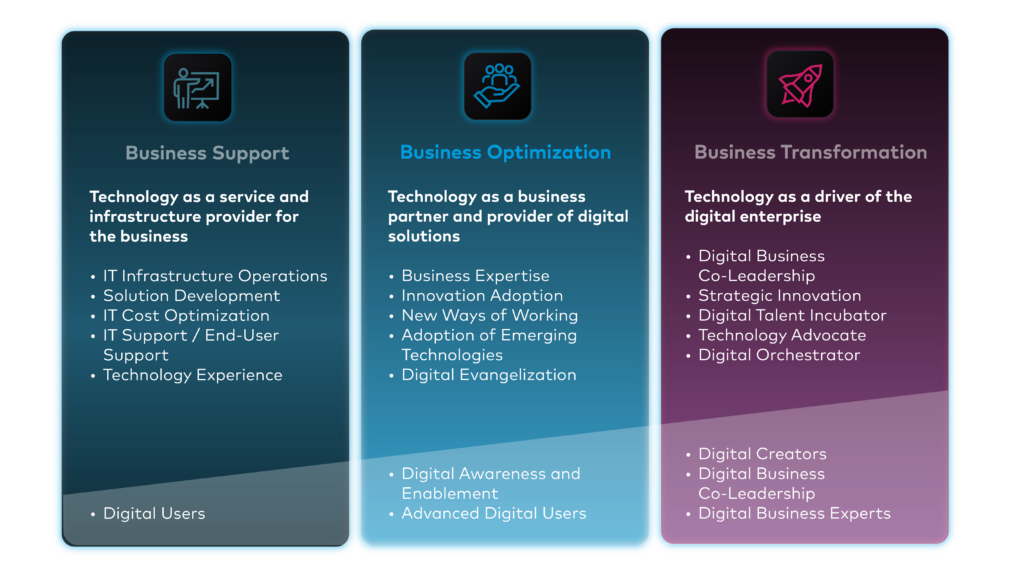
The table below illustrates the evolution of functions in both Technology and Business as organizations advance in their digital transformation.
In the technology domain, the focus evolves from infrastructure management toward strategic leadership and digital innovation. Technology moves from ensuring operational stability to becoming a driver of growth and adaptation.
In parallel, the business area evolves from a passive user to a digital creator and strategic co-leader. This evolution strengthens integration between both functions and enables the capture of new opportunities in a dynamic environment.
5. Start your Tech Talent transformation journey
The time to act is now.
The technology landscape and talent market are evolving rapidly, with no signs of slowing down. The decisions your organization makes today regarding technology talent will shape its competitive advantage tomorrow.
Turn technological evolution into a strategic opportunity. Developing and activating Tech Talent enables organizations to transform challenges into growth and innovation.
Commit to leading the transformation of technology talent. Every step taken to develop and empower your team strengthens organizational resilience. Every initiative drives innovation. Every achievement reinforces your commitment to excellence.
Start today.
Empower your Tech Talent.
Lead with agility and unlock your organization’s full potential.